Scars the Empire Couldn’t Format

Power has always had a favorite battlefield, and it has never been land. It is the human body.
Long before modern theorists coined biopolitics, imperial administrators understood that true sovereignty meant formatting flesh to match the state’s ledger. Michel Foucault wrote that institutions map bodies the way cartographers map borders — but history carries older evidence. In the first century BC, Strabo observed that the Illyrian and Thracian tribes carved their identities directly into their skin. And when archaeologists later unearthed the Bronze and Iron Age sites at Glasinac and Donja Dolina, they found long bronze needles with carved wooden handles buried in the dirt — not for cloth, but for flesh.
The tools of survival are always older than the empire trying to erase them.
And when the world collapses into the Badlands of a totalizing regime, those tools have a way of returning to the light.
The warning didn’t come from church bells. The Ottoman governor had ordered the iron clappers removed years earlier — a neat bureaucratic trick to mute the valleys and prevent dissent.
It came instead through the soles of Kata’s boots: a low-frequency tremor pulsing through the bedrock of the Dinaric Alps.
Winter, 1463.
The air smelled of wet pine, frozen dung, and the metallic scent of imminent collection.
Inside her stone hut, Kata dropped her wooden spoon. Her ears caught the distant acoustics of imperial efficiency: unshod cavalry horses pounding the frozen earth, chainmail sloshing against oiled leather. The Sipahi were moving up the valley.
Mara stood by the window, breath fogging into white frost. Thirteen years old. Wild-honey hair. Pale, flawless skin. Exactly what the empire’s acquisition ledgers demanded.
The older women at the well whispered the same grim gossip: the devşirme, the blood tax. Boys taken for Janissary conversion. Girls erased into elite households, their names and lineages overwritten by law.
“Mama?” Mara whispered. “The horses have passed the mill.”
“Do not speak,” Kata said, her voice flattening into a terrifying calm. “Strip your shawl. Open your collar.”
There was no time for ritual sicanje. No elders. No clean pigment. Only survival.
Kata scraped soot from the hearth, mixed it with gunpowder hidden beneath the floorboards, and spat into the bowl to bind the grit. She pulled an ordinary sewing needle from her skirt.
“Bite your sleeve,” she said, pinning Mara against the wall. “If you scream, they will hear. If they hear, they will take you. And you will spend your life as a ghost.”
Mara bit down hard.
Kata dipped the needle into the black sludge and drove it into her daughter’s chest.
Puncture. Drag. Puncture. Drag.
Blood welled instantly, mixing with soot and powder. The room shrank to the sound of Mara’s strangled breaths and the wet pop of the needle tearing through skin.
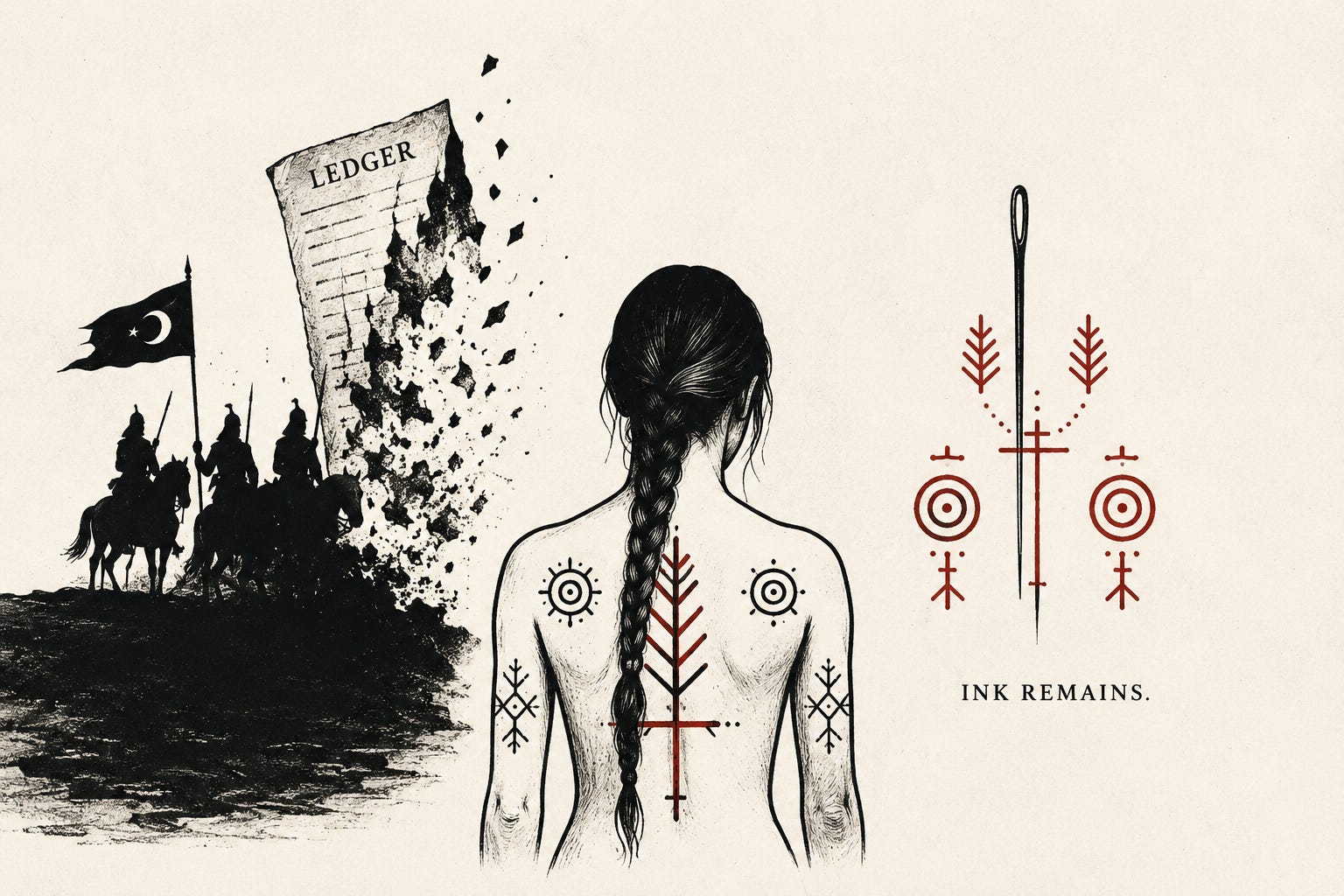
Kata worked with the frantic precision of a soldier loading a musket. She carved the jelica — the fir-branch cross — down the sternum. Then the ograda on the wrist, the protective fence. Then the concentric kolo circles, the dance of the mountains.
Outside, timber splintered. A woman screamed. Iron horse-bitts clinked right outside their door.
“Hold still, my little bird,” Kata whispered, her fingers slick with blood. “The pain is keeping you here.”
A shadow fell across the threshold. The latch rattled.
Kata dropped the needle into the ashes. She grabbed a filthy rag and smeared the wounds, making the fresh ink look even angrier, even more permanent.
“Stand tall,” she hissed. “Do not cover your chest.”
The door blasted inward.
An Ottoman Sipahi filled the frame — an imperial auditor with a scimitar, smelling of damp horsehide and rancid tallow. His eyes locked onto Mara. He stepped forward, grabbed her jaw, and yanked her face into the light.
Then he saw her throat.
He froze.
The skin that should have been a pristine canvas was a mutilated, bleeding cross — flanked by pagan solar circles. Her wrists carried more marks. Her hands, too.
To the empire’s jurisprudence, she was no longer a prize. She was a contaminant.
The soldier recoiled, spat a curse, wiped his glove in disgust, and turned on his heel.
“Defective,” he growled to the headman outside.
The door slammed shut.
For a long moment, the hut was silent. They listened to the horses turn around. They listened to the troop ride toward a village whose mothers hadn’t yet found their needles.
Mara let her sleeve fall from her mouth. Her chest burned with white-hot agony. But when she looked down at the dark, swollen lines carved into her skin, the terror evaporated.
It was replaced by a gritty, shocking sense of victory.
Kata collapsed to her knees, sobbing into her daughter’s skirt — the manic relief of a woman who had just stolen her child back from the claw of an empire.
But Mara didn’t cry. She stood upright in the freezing mud, touching the weeping cross on her sternum.
The ink was a scar. But it was also a fortress.
The empire had come with its armies, its ledgers, its mandate for control — and a peasant mother had broken their machine with a sewing needle and a handful of soot.
She was ruined for their world. And because she was ruined, she was free.
The ultimate joke of history is that the paperwork of power always burns, but the ink in the dirt remains.
Where is the Ottoman Empire now? A footnote.
Where are the communist authorities of Yugoslavia who tried to suppress sicanje as superstition? Gone. Their banners rot in museum basements.
But five hundred years later, the marked ones are still here.
From Paris to Central Bosnia, a new generation is hand-poking the same crosses, pine branches, and solar circles into their skin — reclaiming ancestral sovereignty with needles older than any empire.
In 2026, those same markings took the international stage, worn proudly by performers who understood exactly what they carried: a lineage of defiance.
We all eventually wander through the Badlands of systems that want to flatten our edges and audit our souls. But the human spirit cannot be formatted.
We survive by holding the line, recognizing our fellow travellers by the scars they choose to bear, and outlasting the machinery until we can look the empire’s empty grave in the eye —
and let out a dark, triumphant laugh.
Das, this piece weaves history, tension, and philosophy together without ever losing its emotional core. It demands to be read, and it leaves me feeling fiercely protective of my own edges and scars. You made me realize that sometimes, becoming defective to the system is the only true path to sovereignty.