

The Caustic Color of Commitment

The Caustic Color of Commitment
The Thirty-Year Sentence
In Ancient Rome, the structural integrity of the empire did not rest solely on the edges of the legionnaires’ swords, but on the terrified patience of six women.
These were the Vestal Virgins. Chosen between the ages of six and ten, they served a thirty-year sentence of sanctity. Their job description was singular and high-stakes: Do not let the flame go out. The Romans believed that Vesta’s fire was the soul of the city. If it burned, Rome stood. If it died, the protective walls of the empire were spiritually breached.
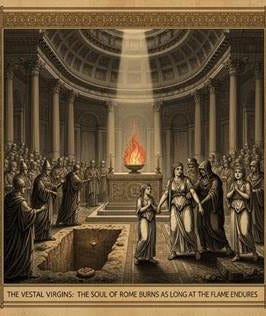
The contract was brutal. If a Vestal succeeded, she was revered. But if the fire sputtered out—or if she broke her vow of chastity—it was viewed as a structural failure of the state. Rome did not execute these women; it erased them. The offending Virgin was placed on a funeral bier, carried in a silent procession to the “Evil Field” (Campus Sceleratus), and buried alive in an underground chamber with a loaf of bread, a little water, and a lamp.

Rome understood a dark economic truth that the modern world tries to curate out of existence: Safety is expensive. The preservation of the collective requires a total, terrifying investment from the individual. You cannot have the “tenderness” of a safe city without the “hardness” of a buried woman.
The Cesspool of the School Run
I think of the Vestals as I stand outside my children’s school. I have been here for twenty years on the trot. It started with the eldest, now navigating her start-up days, and continues with the tiniest in prep school. I am the modern keeper of the flame, but there is no reverence here. There is only the waiting, the engine idling, and the boy in between who has nothing to say.
I feel mentally sullied. I want to give up. The routine has blurred into a depression where my internal hole remains unfulfilled. For months, I treated this self-pity as a wading pool, but it quickly deepened into a cesspool. It was accommodating; it required no permission to enter and set no checkout time. It was a dark place, but a holiday spot nonetheless. I ordered a mental cocktail and refused to leave.
I look around at the other parents. We are the Vestals of the suburb. We are serving our thirty-year sentences, terrified that if we look away, the flame—our children’s future—will go out. But unlike the Romans, no one is cheering for us. We are just the traffic.
The Ink of the Yakuza
Then, I saw the women documented by photographer Chloé Jafé in her project “I give you my life” (Inochi azukemasu). She captured the wives of the Yakuza.

To an untrained eye, the photos show bodies covered in dense, dark ink. To me, it is the caustic color of commitment.
Jafé notes that when we think “Yakuza,” we think of men in suits with missing pinky fingers. But the women play the ambiguous, interstitial role. They are the “grease.” Without the grease, the machine seizes. I go back to these pictures to understand that any long-standing relationship is an investment, but some investments defy the logic of the marketplace. They require a currency I have been afraid to spend.
Why do they do it? Why turn your skin into a canvas of pain?
Science calls it Costly Signaling Theory. For a commitment to create genuine safety in a high-stakes environment, it must be too expensive to fake. Anyone can say “I love you” or “I am loyal.” Talk is cheap. But to endure the needle for hundreds of hours, to risk liver damage, to permanently mark yourself as an outcast from polite society? That is a signal that cannot be counterfeited.

The Yakuza wife experiences Identity Fusion. She does not just “support” the clan; she dissolves into it. Her survival is their survival. The tattoo is a covering, a shield. It signals to the clan: I have burned the bridge back to normal society. I am safe to trust because I have nowhere else to go.
Only inside that fortress of costly ink can any tenderness exist. The safety of the inner circle is purchased by the scarring of the outer skin.
The Human Pillar
This logic—that stability requires a sacrificial cost—is not unique to the Japanese underworld. It echoes the grim architectural legend of Hitobashira, or “Human Pillars.”
In feudal Japan, it was believed that difficult construction projects—castles, bridges, or dams against flooding rivers—would inevitably collapse unless a living human was buried within the foundation as a sacrifice to the gods. The Maruoka Castle in Sakai, for instance, is said to stand only because a one-eyed peasant woman named Oshizu was buried alive in the central pillar to appease the spirits.
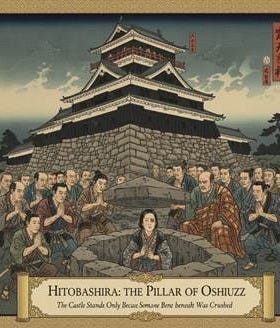
The architectural integrity of the structure depended on the consumption of a person. The castle stood tall only because someone beneath it was crushed.
It is a cynical, horrifying anecdote, but it illuminates the architecture of family. We look at the “Great Men” or the “Thriving Children” (the castles) and admire their height. We rarely ask about the Hitobashira in the foundation. We rarely ask about the grease.
Consider Sofia Tolstoy. While Leo Tolstoy was hailed as a literary prophet for writing War and Peace, it was Sofia who sat by candlelight, deciphering his impossible, microscopic handwriting. She copied the massive manuscript by hand not once, but seven times. She bore him thirteen children, managed the estate, and endured his fanatical mood swings.

Leo was the Castle; Sofia was the Human Pillar. She was the grease. Without her invisible, grinding labor, the genius of Tolstoy would have collapsed under its own weight.
The Trap of Effort Justification
But there is a trap here, one that I feel in my own bones as I sit in the car. It is called Effort Justification.
When we suffer this much—when we endure the tattoos, the burials, the waiting—our brains scramble to make sense of it. We tell ourselves the cause must be sacred, or else we are just victims. The Yakuza wife endures the tattoo to prove to herself that the life is worth it. The Vestal Virgin protects the fire to justify her stolen childhood.
I look at the school gate. My twenty years of waiting is also a “Costly Signal,” but it is written in time, not ink. It is invisible. That is why it feels empty—because I haven’t ritualized it. I haven’t viewed the grease as sacred; I viewed it as servitude.
I am leaving my wallow pit now. I am walking into the broad sunlight of reality. I realize that the “hole” in my chest isn’t from a lack of freedom; it’s from a lack of reverence for my own burden.
Safety is expensive. The tenderness of my children—their ability to walk through the world with confidence—is paid for by my boredom. I am the shield. I am the Hitobashira. Being the grease is not a failure of ambition; it is the physics that keeps the world from grinding to a halt.
The Caustic Reality
The bell rings. The gates open.
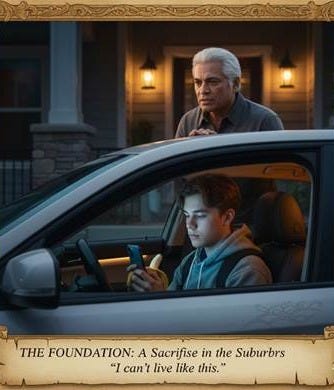
My son walks out. He is the castle; I am the foundation. He is the flame; I am the Vestal.
I unlock the car door, feeling a sudden, noble swell of purpose. I am the Yakuza wife. I am the guardian of the sacred fire. I wait for him to acknowledge the profound, crushing cost of my love, the decades of investment that ensure his preservation.
He opens the door, tosses his heavy bag onto the passenger seat, and looks at me with the blank, slightly annoyed stare of a comfortably preserved monarch.
“Did you bring snacks?” he asks, scrolling on his phone. “Also, the hotspot isn’t working. You need to fix it. I can’t live like this.”
I hand him a banana and check the router.
Even the Vestal Virgins probably had to take out the trash.