

The Centrifuge
The Centrifuge, The Gravitons – Directions of where we are going Nowhere!

We ended the last chapter in a difficult place—standing in a room full of “cobras,” those defensive avatars I bred to survive my childhood. It was a heavy realization to admit that my defense mechanisms had become my prison. But if you are walking this road with me, you might be asking a practical question: How did you manage to live like that for thirty-five years? How do you function when your internal world is that dangerous?
The answer is surprisingly simple, though exhausting. You survive by never standing still. You survive by generating enough speed, enough noise, and enough centrifugal force that the snakes are pinned against the wall, unable to strike. You survive by turning your life into a machine that refuses to stop spinning.
The Centrifuge (And the House Built to Nowhere)
There is a ride at the old carnivals called the Gravitons. You stand inside a metal drum, your back pressed against a padded panel. The music starts—loud, thumping, chaotic. The drum begins to spin. Faster and faster.
Suddenly, the floor drops out from under you.

But you don’t fall. The centrifugal force pins you to the wall. You are suspended in the air, held up by nothing but speed. You feel heavy, pressed, and strangely secure. As long as the machine keeps spinning, gravity cannot touch you.
For thirty-five years, I have been living inside a Gravitron.
I have mistaken “G-Force” for “Grounding.” I thought that because I felt the pressure of work, the weight of stress, and the blur of movement, I was standing on solid earth.
I wasn’t. I was just spinning.
The Sarah Winchester Strategy
This need for artificial gravity is not unique to me. In 1884, the heiress Sarah Winchester moved to California convinced she was cursed. A medium told her that the spirits of those killed by Winchester rifles were coming for her. The instruction was specific: “Build a house. If you stop building, you die.”
So, she hired carpenters to work 24 hours a day, 365 days a year, for thirty-eight years. She wasn’t building a home; she was building a labyrinth to confuse the ghosts. She built stairs that led to the ceiling and doors that opened onto solid walls.
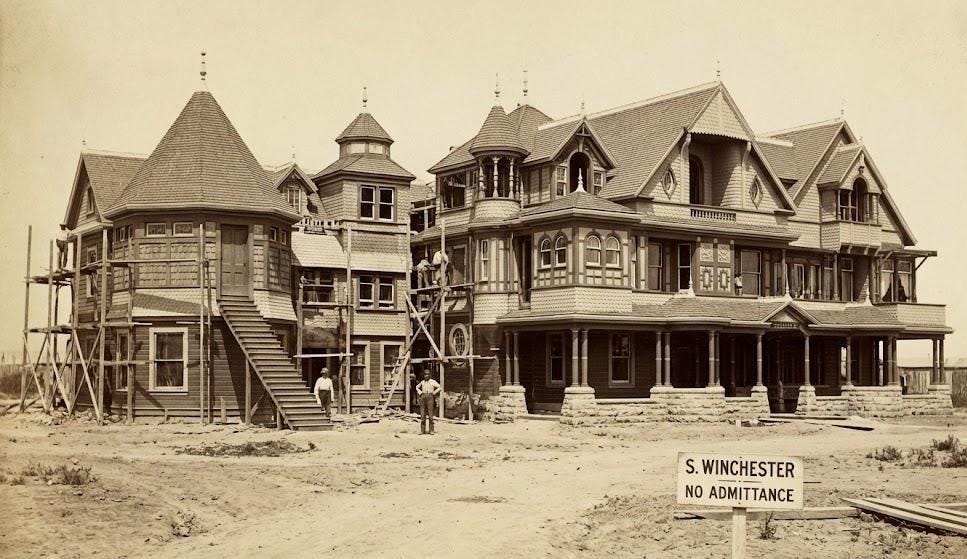
She wasn’t trying to finish the house. She was just trying to keep the hammers moving. As long as the noise of construction filled the air, the silence—and the ghosts within it—could not enter.
I have been Sarah Winchester. I built the Quinto wing in Chennai. I added the Confluence extension in Bangalore. I constructed the Tribal Arts turret in the North.
To the observer, this looked like a career. To the man inside, it was just the noise of hammers keeping the “Empty Room” at bay.
The Red Queen’s Race
Why did I keep building? Why did I keep spinning the drum?
Because I am trapped in what evolutionary biologists call the Red Queen Hypothesis.
In Lewis Carroll’s Through the Looking-Glass, the Red Queen grabs Alice’s hand and they run faster and faster, the wind whistling, the trees blurring. Finally, they stop, gasping for air. Alice looks around and realizes they are standing under the exact same tree.

“In our country,” Alice says, “you’d generally get to somewhere else—if you ran very fast for a long time.”
“A slow sort of country!” says the Queen. “Now, here, you see, it takes all the running you can do, to keep in the same place.”
I have been the Red Queen. I ran the startups, the headhunting, and the social work not to get somewhere, but simply to stay in the same place—to keep the “Avatar” of the successful, relevant man alive.
The New Wing: The Writer’s Studio
Now, the drum is slowing down. The “Interjection” has arrived. So, what does a desperate builder do? He tries to start a new project.
Writing is my new diversion.
I’ve got the bug. The “itch” to write plays on my mind. I tell myself, “Hello, I am doing my book today.”
I read about the Haruki Murakami who enters his studio at 5:00 AM and leaves at 11:00 AM. He ignores guests, family, and emergencies to produce his 1,500 words.
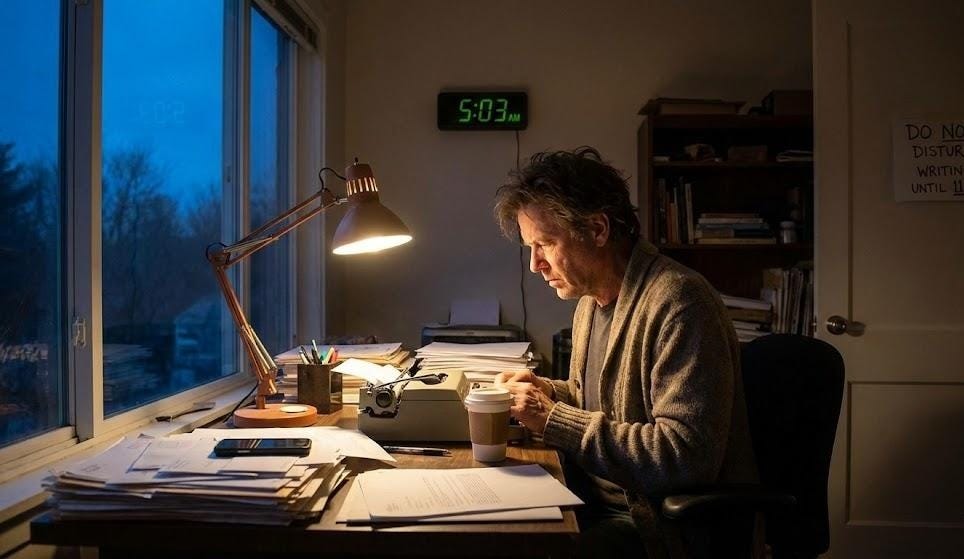
I look at that discipline and I crave it. I want to trim all the unnecessary rules to get back to this inner core. I want to be like Hermann Hesse or C.S. Lewis or Tolkien. I want to write humongous amounts of short stories.
But this “itch” is suspicious. It feels less like inspiration and more like the desperate need to hear the hammers again.
My portfolio is filled with “police scrubs” of uncompleted work. No plot. No great ideas. Just the lethargy of a man trying to build a paper wall to keep out the void.
The War: The Wellspring vs. The Grinding
I am stuck because I am trying to build this new wing with the wrong materials.
I was listening to John Eldredge, author of Wild at Heart. He talks about “ransoming the heart,” quoting Proverbs that the heart is the “wellspring of life.”
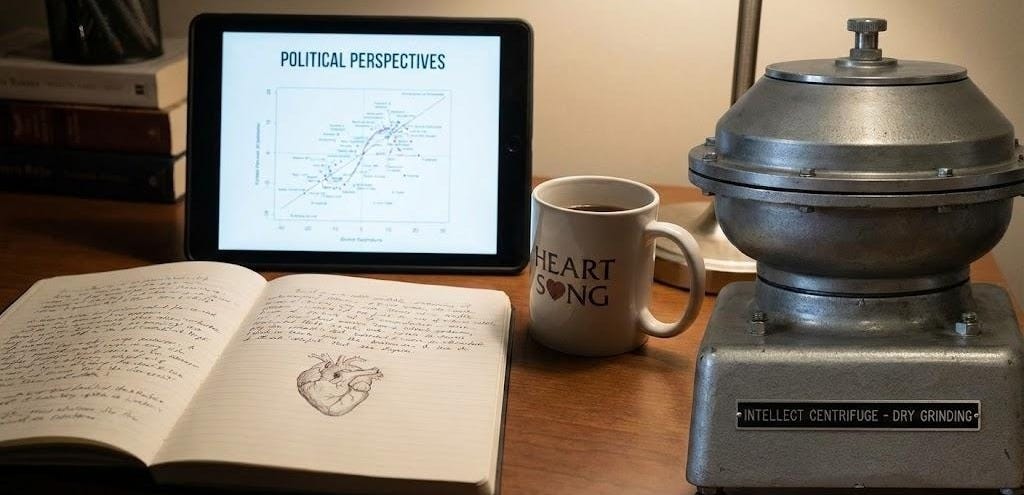
When I write for the heart, it feels warm, personal, touching. It feels like the Heart Song from the movie Happy Feet—a tune valued above everything else.
But then the Centrifuge kicks in. The intellect takes over. The writing shifts to “Perspectives,” “Politics,” and “Anthropology.” It becomes remote. Alien. It becomes “Dry Grinding.”
I am trying to write a Heart Song with a Head Strategy. I want the soulful resonance of Hesse’s Siddhartha sitting by the river, but I am using the frantic energy of a startup founder pitching a VC.
The Fear of the Kabariwala (Scrap dealer)
The ultimate proof that this is a “False Well-Being Symptom”—a diversion—is my paralyzing fear of the audience.
I met Pieter Kwant, the publisher with Langham Fellowship. He told me: “Before you get into writing, worry about your audience. If you don’t know who you are addressing, you don’t know the story.”
He is right. But his logic terrified me.
I thought of William Hazlitt, who railed against the “Ignorance of the Learned” and wrote what he pleased, leaving it to Providence to find the reader.

But I don’t have Hazlitt’s courage. I am terrified that a publisher will look at my manuscript, fail to see the “market,” and put it on the back burner. He will sit there in hope, while actually collecting the trash to sell to the Kabariwala (the scrap dealer).
If I were truly writing to heal, I wouldn’t care about the Kabariwala. But because I am writing to prove I exist—to keep the Red Queen running—the thought of being discarded destroys me.
So where are you going?
I am reminded of an old story about a man galloping on a horse, riding furiously down a country road. He looks determined, important, a man on a mission. A peasant standing in the fields watches him fly by in a cloud of dust and shouts, “Where are you going?” The rider turns his head and shouts back, “I don’t know! Ask the horse!”
So here I am, frantic, holding a pen, terrified of the scrap dealer, trying to be C.S. Lewis by 11:00 AM.
It reminds me of the old joke about the airline pilot who comes over the intercom to address the passengers.
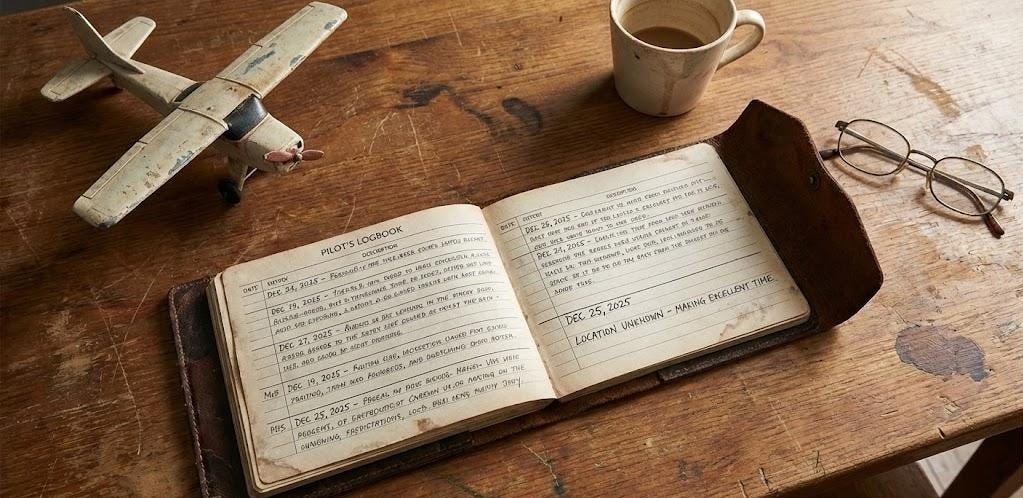
“Ladies and gentlemen,” the captain says, “I have some bad news and some good news. The bad news is that our navigational systems have failed, our radar is broken, and we are completely lost. We have no idea where we are or where we are going.”
The passengers gasp in terror.
“But,” the captain continues cheerfully, “the good news is that we are making excellent time!”
For thirty-five years, my ambition, my fear, and my trauma have been the horse. I have just been the passenger, holding on for dear life, pretending I was steering. For thirty-five years, I have been making excellent time. I just wish I knew where I was going…….